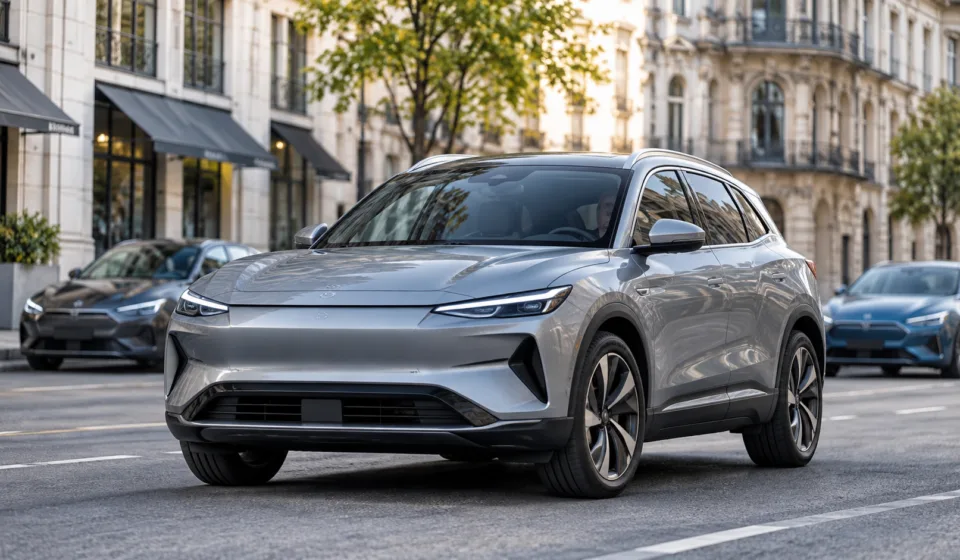
Slightly more than one in every ten new passenger cars registered across the Western European markets covered by the data in the second quarter of 2026 came from a Chinese brand.
فهرست مطالب
- What the 10.7% Figure Actually Means
- 1. The Cost Advantage Begins Before the Showroom
- 2. Battery Expertise Creates More Than a Pricing Advantage
- 3. The Competition Extends Beyond Battery-Electric Cars
- 4. Local Production Is the Next Phase
- Have Established European Brands Lost the Race?
- What Should Buyers Take From This?
- Frequently Asked Questions
- What share of Western Europe’s car market did Chinese brands hold?
- Does the 10.7% figure refer only to electric cars?
- Are all Chinese cars cheaper than European alternatives?
- Does manufacturing in Europe eliminate every tariff?
- The Bottom Line
Their combined market share reached 10.7%, up from 5.7% a year earlier, according to Schmidt Automotive Research data reported by the South China Morning Post.[1][2]
The figures cover 18 Western European countries. They do not refer exclusively to battery-electric vehicles, and they should not be treated as a measure of the entire European continent.
The increase is substantial. But “taking over Europe” would overstate what the numbers show. A more useful question is how Chinese brands are expanding their presence—and what they need to do to make that growth last.
What the 10.7% Figure Actually Means
Market share, growth in market share and growth in vehicle sales are different measures.
| Measure | Figure |
|---|---|
| Chinese brands’ market share, Q2 2025 | 5.7% |
| Chinese brands’ market share, Q2 2026 | 10.7% |
| Increase in market share | 5 percentage points |
| Relative increase in market share | Approximately 88% |
| Geographic coverage | 18 Western European countries |
| Market covered | New passenger cars, not just EVs |
Market-share figures: Schmidt Automotive Research and SCMP. Changes calculated from the reported figures.[1][2]
It is accurate to say that Chinese brands nearly doubled their market share. It is not possible to conclude from those percentages alone that their sales volume nearly doubled. That calculation would also require the total market size in both periods.
Another distinction matters: a Chinese brand is not the same thing as a Chinese-built car. A non-Chinese brand can manufacture vehicles in China, while a Chinese brand can produce vehicles elsewhere. That difference is particularly important when discussing tariffs.
1. The Cost Advantage Begins Before the Showroom
Competitive pricing is an important part of the explanation, but its foundations lie deeper than retail discounts.
Manufacturing scale, supplier networks, domestic competition and battery costs all influence how much it costs to bring a vehicle to market.
In its Global EV Outlook 2026, the International Energy Agency reported that average battery pack prices per kilowatt-hour in China were 35% lower than in Europe in 2025.[3]
That measure covers regional battery averages across electric vehicles and stationary storage applications. It is not a direct comparison of the battery fitted to every competing car, nor does it mean that Chinese vehicles should cost 35% less.
Nevertheless, it illustrates why access to a competitive battery supply chain matters.
The IEA’s 2025 analysis also identified falling battery costs, supply-chain integration and intense competition as contributors to improving electric-car affordability in China.[4]
Lower production costs do not automatically translate into lower European retail prices. Shipping, taxes, tariffs, equipment, distribution and brand positioning all affect what the customer ultimately pays.
2. Battery Expertise Creates More Than a Pricing Advantage
A battery influences both the cost of an electric car and the experience of owning it.
Range, vehicle weight, charging performance and behavior in different temperatures depend on the technology selected and how the vehicle is engineered.
The IEA identifies China as the main center of production and supply-chain expertise for lithium iron phosphate, or LFP, batteries. These batteries can help lower EV production costs, although they also involve design trade-offs.[3]
For an automaker, that industrial base creates options: different combinations of price, range and equipment can be developed for different customers.
For a buyer, however, the result must be assessed at the model level. A country’s strength in battery manufacturing does not establish that every vehicle produced there has superior technology.
Charging claims also need context. Peak charging power alone does not reveal how long a stop will take. Battery temperature, charger capability and the amount of time the car can sustain high charging power all matter.
3. The Competition Extends Beyond Battery-Electric Cars
The distinction between battery-electric vehicles and plug-in hybrids helps explain the strategic choices facing manufacturers in Europe.
From 30 October 2024, the European Union applied definitive countervailing duties to covered battery-electric vehicles originating in China. The original schedule included additional duties of 17% for BYD, 18.8% for Geely and 35.3% for SAIC.[5]
These were additional countervailing duties, not a statement of the full import cost. The rules concern vehicle origin and classification rather than the nationality of the badge alone. Tesla’s Shanghai operation, for example, received its own rate in the same schedule.
Conventional plug-in hybrids fall outside those specific battery-electric vehicle countervailing duties. That distinction can influence which products manufacturers choose to offer. It does not mean that plug-in hybrids face no import duties or other regulatory requirements.
They can also appeal to buyers who want some electric driving without relying exclusively on charging infrastructure.
The ownership case still depends on how the vehicle is used. Fuel savings from a plug-in hybrid are strongly influenced by regular charging and driving patterns; advertised consumption is not a guarantee of every owner’s real-world result.
4. Local Production Is the Next Phase
Exporting can establish a foothold. Local manufacturing can help turn that foothold into a longer-term presence.
On 23 July 2026, Geely and Ford announced an agreement to form a manufacturing joint venture at Ford’s Valencia plant in Spain. The proposed ownership structure gives Geely 34% and Ford 66%.[6]
According to the companies’ announcement, the venture is expected to begin operations in the first half of 2027, subject to regulatory approvals. The first new vehicles are scheduled for production in 2028.
This project should not be presented as a cause of the market-share increase in Q2 2026: the announcement came after that quarter ended.
Its significance is forward-looking. Shared factory capacity, development costs and production closer to customers could shape the next stage of competition.
Local manufacturing is not a universal solution, either. Labor and energy costs, supplier availability, production scale and rules of origin still influence whether a project makes commercial sense.
Have Established European Brands Lost the Race?
A 10.7% share signals a meaningful shift, not the end of the contest.
Established manufacturers can respond with more affordable products, lower costs, industrial partnerships and stronger ownership support. The IEA has documented plans for lower-priced electric models from both European and non-European manufacturers.[4]
Chinese brands, meanwhile, face a challenge that extends beyond winning the first sale.
Parts availability, repair capacity, warranty support, insurance costs and used-car values can become as important as the initial purchase price.
That is why market share should be considered alongside profitability, repeat purchases and the quality of the service network. Rapid expansion is one achievement; sustaining customer confidence is another.
What Should Buyers Take From This?
A brand’s growing European market share is a reason to consider it, not a substitute for evaluating a specific vehicle.
Buyers should check:
- The exact specification sold in their country.
- Independent safety results relevant to that version.
- Written vehicle and battery warranty terms.
- The location and capability of authorized repair centers.
- Parts availability and likely repair costs.
- Insurance quotations and realistic charging needs.
- Available evidence on reliability and resale values.
These checks matter especially when comparing versions sold in different countries. A model name can remain the same while its battery, powertrain, safety equipment or warranty changes.
Industrial competitiveness and individual purchase value are related, but they are not interchangeable.
Frequently Asked Questions
What share of Western Europe’s car market did Chinese brands hold?
They held 10.7% in Q2 2026 across 18 Western European countries, up from 5.7% a year earlier, according to Schmidt Automotive Research data reported by SCMP.
Does the 10.7% figure refer only to electric cars?
No. The headline figure covers the new passenger-car market, not just battery-electric vehicles. Powertrain-specific shares need to be examined separately using consistent geography and time periods.
Are all Chinese cars cheaper than European alternatives?
No. A manufacturing cost advantage can support competitive pricing, but the final price depends on the model, equipment, taxes, tariffs and country of sale.
Does manufacturing in Europe eliminate every tariff?
No. The outcome depends on the applicable trade rules, origin requirements, components and manufacturing arrangements. A local factory does not automatically resolve every trade issue.
The Bottom Line
Chinese brands’ expanding share of Western Europe’s car market reflects a contest that begins with batteries and supply chains and extends to product choice, pricing and local operations.
Market-share data alone cannot tell us precisely how much each factor contributed. What they show is a larger commercial presence. What remains to be demonstrated is how consistently that presence can translate into profitable operations and dependable ownership.
The next test is not simply how many cars these brands can sell. It is how well they support the people who buy them.
source:
Q2 2026 Quarterly Chinese Passenger Car Manufacturer Performance Study
Europe’s new EV power struggle sees Chinese giants seize record market share
Trends in electric car affordability
EU Commission imposes countervailing duties on imports of battery electric vehicles from China